Photo: Pexels / Pixabay
Six Months With the Raknes DM-4: A Mixer That Argues With You
The Norwegian-designed four-channel rotary arrives with a controversial built-in sidechain bus and a price that will make you wince. Is it genius or gimmick?
Every few years a piece of DJ hardware arrives that doesn’t merely improve on the standard but quietly disputes it. The Raknes DM-4, a four-channel rotary mixer built in a small workshop outside Bergen, is one of those. After six months in a home studio and a dozen club nights, I still haven’t decided whether to love it or throw it out a window.
It costs €3,890. That’s roughly €700 more than the most common club rotary, and about double what most DJs spend on a mixer. For that you get a brutally handsome object: a 4 kg anodised aluminium chassis, 45 mm stepped-detent faders, and a sound that reviewers keep describing as “honest” — a word that usually means “slightly boring” but here means something closer to “unforgiving.”
The sound
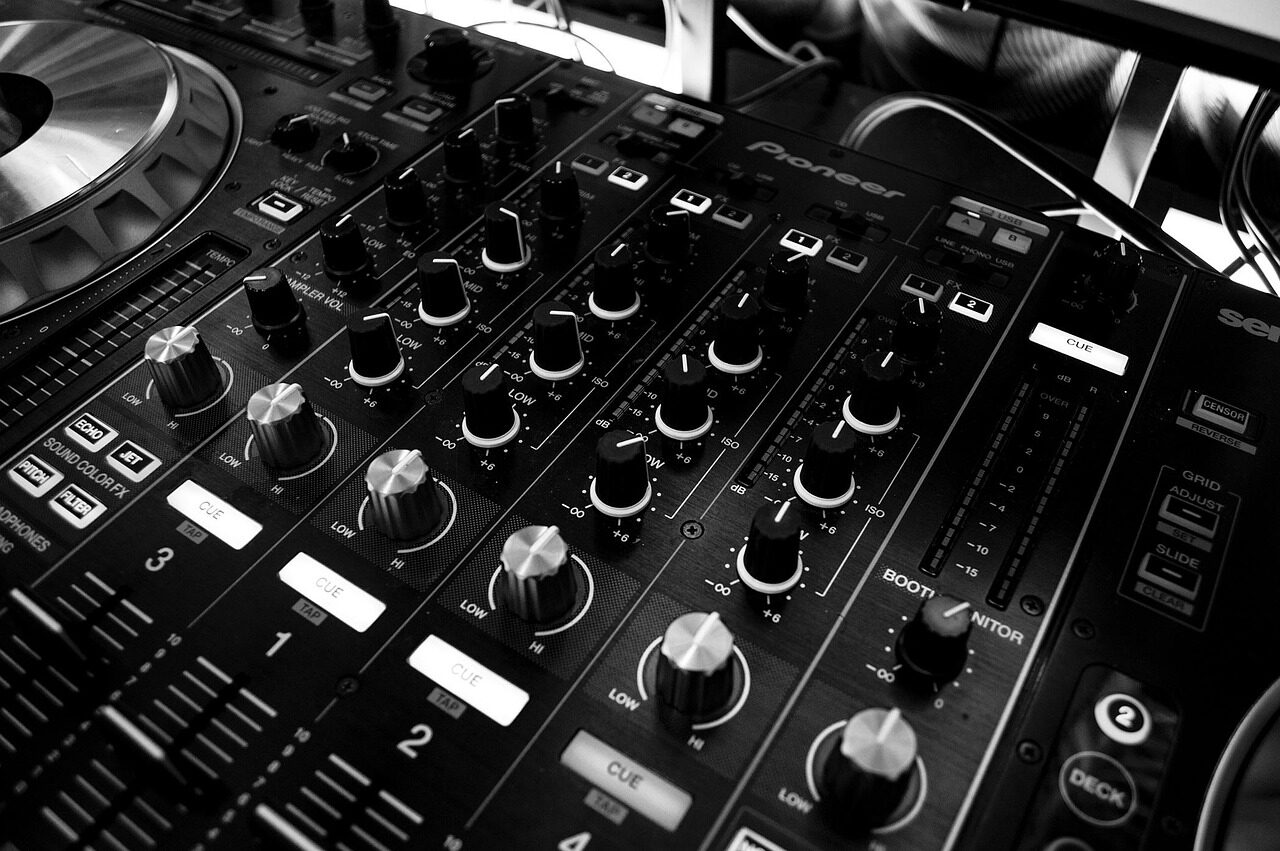
The DM-4 uses discrete Class A input stages and a fully analogue signal path with no DSP. At low gain it is almost clinical, with a flat response out to 40 kHz and a noise floor that I measured at -94 dBu. Push the input trims and it thickens, a warm, slightly saturated push in the low mids that flatters heavy house and dub techno.
The isolator is the star. Three bands, with crossovers at 180 Hz and 2.2 kHz, and a kill switch that doesn’t click. Taken to full cut, the low band removes the kick entirely, leaving a hollow shell of hats and vocals that can be brought back with a controlled sweep. It’s the cleanest isolator I’ve used, though the cut is steeper than I’d like at 24 dB/octave, which can leave basslines feeling amputated.
The sidechain bus
Here’s where it gets contentious. Between channels three and four sits a small black knob labelled DUCK. It routes the kick drum (detected from channel one’s low band) to a gain-reduction circuit on a user-selected group of channels, with attack, release and depth controls. In practice, it’s a hardware sidechain compressor baked into the mixer.
THE DROP · From the crate: The Eight-Hour Mix: Why Marathon Sets Are Quietly Taking Over Streaming · Photo: Gigxels / Pixabay
“The idea came from watching DJs fake it with the EQ,” says Ingrid Sæther, the DM-4’s lead designer. “They’d ride the low-cut by hand to get that pumping feel. We just put a circuit there.”
It works astonishingly well when you want it to — layering a pad loop under a four-on-the-floor kick, the pump is smooth, musical, repeatable. But it also encourages a certain sound, and after two months I noticed that all my sets pulsed in the same way. I switched it off. It has not been on since.
Build and quirks
The faders are fantastic, with a travel that rewards slow blends. The headphone amp delivers 1.2 watts into 32 ohms, plenty for loud booths. The cue section is a little unusual: a split-cue mode sends the master to the left ear and the cue to the right, which I found disorienting but a few DJs swear by.

From the crate: The Last Field: Can the Mid-Sized Festival Survive 2027? · Photo: OrnaW / Pixabay
The flaws are real. There is no USB audio interface, no recording output and no effects loop beyond a single send/return on channel two. For €3,890, that feels stingy. The rear panel is crowded and the XLR master outs sit uncomfortably close to a power inlet, which I bumped by accident twice.
Then there’s the weight. At 4 kg it’s perfectly portable, but the build is such that I would never check it in luggage. Raknes sells a fitted flight case for another €310, which feels cheeky.
Verdict
The DM-4 is for a narrow audience: the DJ who plays vinyl or high-quality digital through a proper system, who values isolation over effects and who has the discipline not to be seduced by the DUCK knob. For that person, it may be the best mixer money can buy.
For everyone else, there are cheaper, more flexible options. The Raknes argues; it doesn’t accommodate. After six months, I find I respect that. Whether I can afford it is another matter.
Score: 8.5/10
Ayumi writes about emerging scenes, listening spaces and the DJs shaping them, having started out in zine publishing and record-shop culture. She is based in Osaka.
Every track by Ayumi →
Conversation (…)